Empowering Large-Scale Mass Production of Domestic Optical Chips, GTronTec Helps Huayi Yingfei Build a New Benchmark for Intelligent Manufacturing
From the manufacturing of a single chip to the collaboration of an entire factory, the large-scale mass production of optical chips places higher demands on the digitalization, automation, and intelligence capabilities of manufacturing systems.
Recently, GTronTec completed the go-live of the plant-wide CIM project for Huayi Yingfei (Beijing) Optoelectronics Technology Co., Ltd. (hereinafter referred to as "Huayi Yingfei"). Centering on the full optical chip manufacturing process, the two parties jointly built an integrated intelligent manufacturing system covering production, equipment, processes, quality, materials, warehousing, and intelligent knowledge management, driving domestic optical chip manufacturing toward higher efficiency, higher quality, and higher reliability.

The customer Huayi Yingfei is a high-tech enterprise focused on the R&D, manufacturing, packaging, and testing of indium phosphide (InP) optical chips, with products covering applications such as optical communications, data centers, and 5G/6G wireless communications. With the rapid development of industries such as artificial intelligence, data centers, and high-speed communications, demand for optical chips continues to grow. For Huayi Yingfei, how to support large-scale production line operations, improve production efficiency and product quality, and establish a comprehensive manufacturing data system has become an important issue in its smart factory development.
Therefore, Huayi Yingfei joined hands with GTronTec, using plant-wide CIM construction as a lever, to build an intelligent manufacturing system oriented toward large-scale mass production for one of China's first production lines to achieve mass production of indium phosphide (InP) optical chips.

Optical chip manufacturing involves many process steps, sensitive parameters, and complex quality factors. From epitaxy to wafer fabrication, and then to inspection and subsequent packaging and testing, the production process involves a large amount of equipment, process parameters, materials, and quality data. The traditional manufacturing model, which mainly relies on manual records, paper process cards, and stand-alone automation, is gradually becoming unable to meet the efficiency, quality, and traceability requirements of large-scale production.
The core challenges facing Huayi Yingfei are concentrated in several areas:
Difficulty in releasing process parameters. Parameter release relies on manual work, creating a risk of errors during operation.
Equipment status is opaque. There is a lack of unified management of equipment operating data, making equipment anomalies difficult to detect in time and easily causing capacity waste.
Quality anomalies are not detected promptly enough. There is a lack of real-time monitoring of quality data during production, anomaly detection lags, and there is a risk of batch defects.
Product traceability efficiency is insufficient. Production process data is scattered, making it difficult to quickly reconstruct the complete production chain after an anomaly occurs.
Systems and data are fragmented. Systems for equipment, materials, quality, planning, etc. are relatively independent, forming data silos and making it difficult to create a unified production and operations view.
Facing these challenges, Huayi Yingfei needed to establish a plant-wide digital collaboration system that truly connects the production process, equipment status, quality data, and manufacturing knowledge.

Targeting Huayi Yingfei's optical chip manufacturing scenarios, GTronTec built a full-domain digital-intelligence collaborative integrated plant-wide CIM solution, covering five major areas: factory operations, production equipment, material management, control systems, and facility utilities.
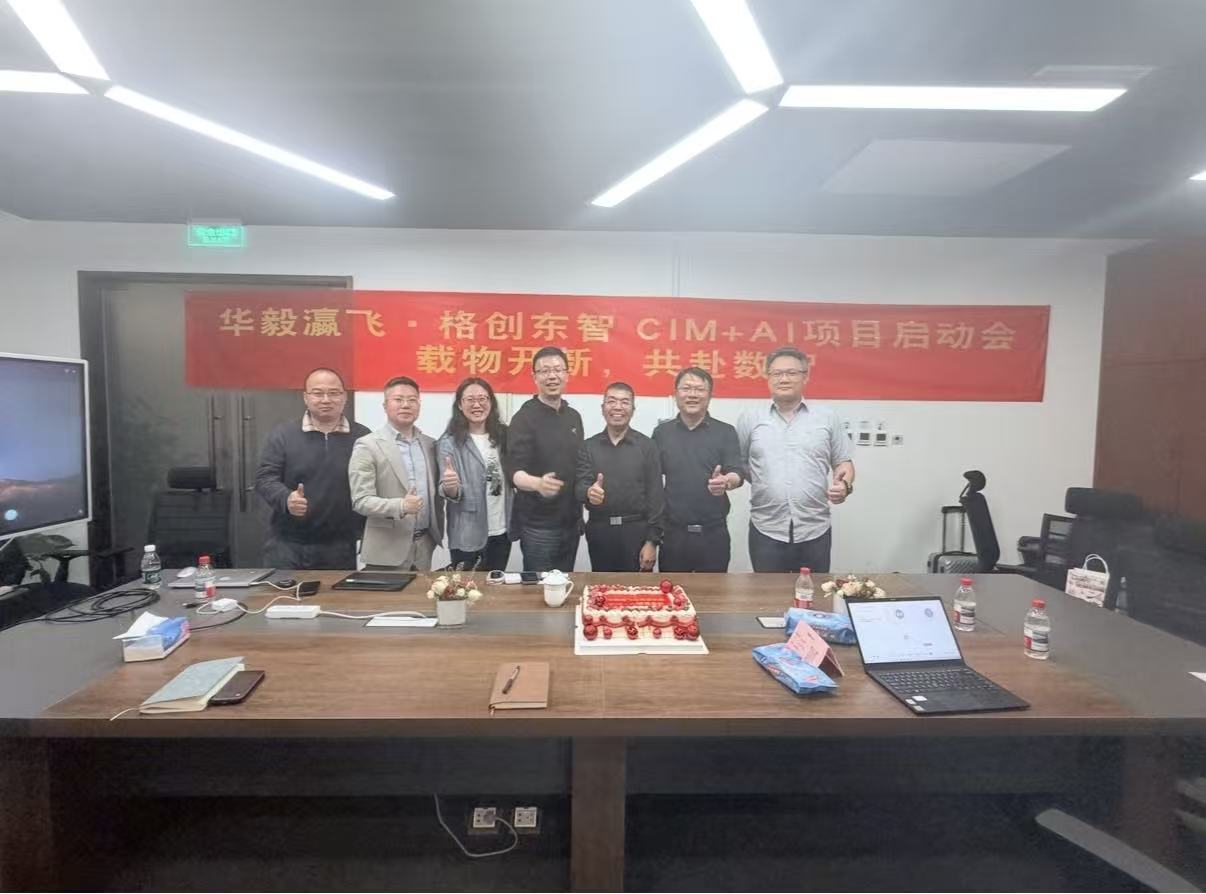
Centering on core areas such as manufacturing execution, equipment automation, process management, quality control, warehousing and logistics, and intelligent knowledge management, the project connected core systems including MES, EAP, RMS, SPC, YMS, DMS, ADC, WMS, and AI KMS, opening up the full-process data chain from material feeding and processing to inspection and shipping.
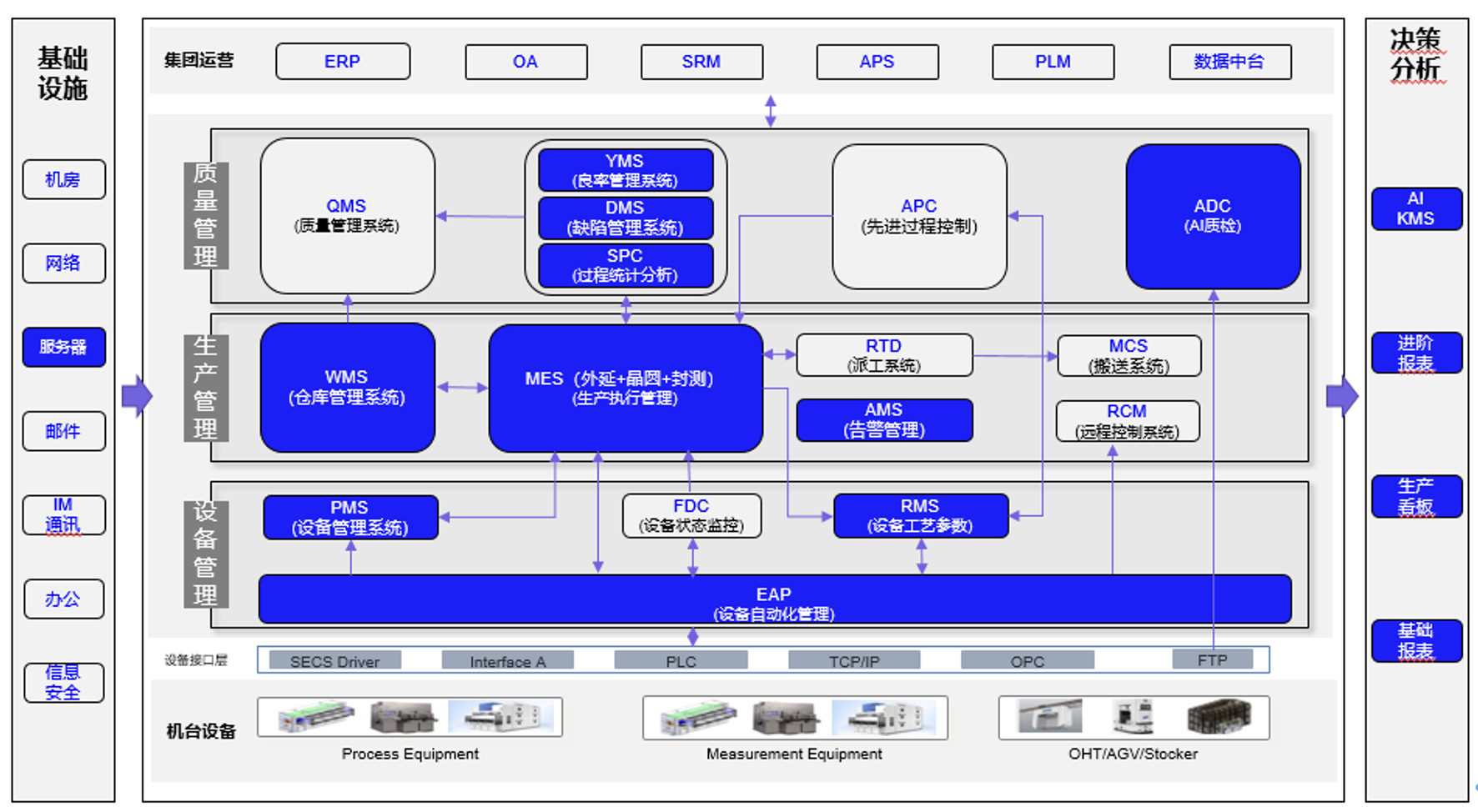
Project Implementation
Production automation: reduce manual intervention. Through deep integration of MES and EAP, full-process automatic control is achieved from wafer feeding to shipping, enabling coordination among production tasks, equipment execution, and process flows.
Real-time quality: move from result inspection to process control. Through real-time collection of full-process data and dynamic SPC monitoring, anomalies in production are identified in a timely manner, enabling rapid detection and interception of quality issues.
Precise recipe and material management: establish full-chain error-proofing. RMS is used for centralized version control of recipes and automatic matching with production processes, while full-process material information is recorded to reduce errors in recipe and material use.
Fine-grained product traceability: enable Wafer/Die-level data traceback. A data chain is built around the product lifecycle, supporting Wafer/Die-level full-chain traceability so that anomalies can be quickly located to the relevant production steps.
Data-driven decision-making: make manufacturing data serve factory operations. Operations dashboards are automatically generated with core metrics such as OEE and yield, helping managers keep abreast of production line status and providing data support for production and operations decisions.
At the same time, the project introduced AI KMS to further connect manufacturing data with industrial knowledge, laying a foundation for accumulating manufacturing experience and future intelligent decision-making applications.

Through plant-wide CIM construction, Huayi Yingfei achieved data connectivity across core areas such as production, equipment, quality, and materials, further improving manufacturing process transparency and operations management capabilities.
1.Production efficiency improved. Full-process automatic control is achieved from wafer feeding to shipping; with deep MES-EAP integration, manual intervention is reduced by more than 80%, and production cycle time is shortened by more than 15%.
2.Quality capability improved. Through real-time collection of full-process data and dynamic SPC monitoring, anomalies can be detected and intercepted within minutes, increasing yield by 3–5 percentage points.
3.Material management improved. Through centralized version control and automatic matching of recipes, combined with full-chain material records, 100% error-proofing and traceability are achieved.
4.Traceability efficiency improved. Support Wafer/Die-level full-chain data traceback, completing root-cause localization within 5 minutes.
5.Equipment operations improved. Dashboards of core metrics such as OEE make production line status transparent, increasing OEE by 10% and reducing equipment downtime by 20%.
Behind these figures are concrete changes as optical chip manufacturing moves from manual-driven to system collaboration and from experience-based management to data-driven operations.
From full-process production digitalization to equipment-system collaboration, and further to the integration of industrial data and manufacturing knowledge, Huayi Yingfei's plant-wide CIM practice has built a more solid digital foundation for the large-scale mass production of domestic optical chips.
In the future, GTronTec will continue to deepen its work in semiconductor intelligent manufacturing, using industrial AI and intelligent manufacturing technologies to drive continuous evolution of manufacturing systems and support the digital and intelligent upgrading of more advanced manufacturing enterprises.